
ATM: Reverse PIN
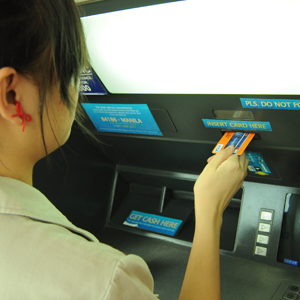
Like everyone else, we often get tips via email. These tips include those that involve security. Most of these discussed the modus operandi and the victim’s experience. I always try to confirm, correct, debunk or add my inputs when I get such e-mails from friends.
This time we will look into a circulating e-mail on a supposed duress code when forced to withdraw money using your Automated Teller Machine (ATM).
Here is the email:
When a thief forces you to take money from the ATM, do not argue or resist. You might not know what he or she might do to you. What you should do is to punch your PIN in the reverse mode.
I.e. if your PIN # is 1254, you punch 4521.The moment you punch in the reverse mode, the money will come out, but will be stuck into the machine half way out and it will alert the Police (security) without the notice of the thief. Every ATM has it; it is especially made to signify danger and help. Not everyone is aware of this. Forward this to all your loved ones, friends and those you care about.
Regards,
Wilfredo E. Bambasi, Jr.
Bank of the Philippine Islands
Systems Programmer
ISG/DPO/Mainframe Technical Support
Initially, I was not interested to deal with this e-mail because it seemed like a spam. However, as more e-mail messages from executives and security professionals are coming in and bloggers are reposting the same advice, I know I should take the e-mail seriously.
This was definitely written by a non-security person who may have only good intentions but not the facts. Note that the writer wrote, “It will alert the Police (security) without the notice of the thief.”
If a person uses force, coercion, intimidation or weapon upon another to get something, it is robbery. The perpetrator in this case should be called a robber, not a thief.
The e-mail, which started circulating in 2006, mentioned a systems programmer of the Bank of the Philippine Islands (BPI). Because of this, many people assumed this was a credible e-mail and not a spam. However, BPI has already made an official statement that this e-mail advisory is a hoax.
Moreover, most ATM systems do not allow use of repeating number sequence like 1111, 2222, 3333, but they accommodate palindromic numbers like 123321, 3443. So how will you reverse a palindromic PIN?
Even if the cash gets stuck in the ATM and the police are on their way, the robber can easily run away. The police are not that fast to respond, even in the U.S.
There is however truth to the e-mail as far as the existence of ATM machines where you can punch your pin in reverse manner. The concept was patented by Joseph Zingher, a businessman from Chicago, who sold his Safety PIN system to banks in the United States. The system existed in few a states that enacted the system into a law. However, almost no banks are into the idea that is why only a few knew.
In reality, any person under threat, coercion or with a gun pointed at his back might not instantly remember to reverse his PIN.
SecurityMatters ™ Magazine advises:
1. If someone forces you to withdraw money from the ATM, choose one inside a mall or a hotel. These are places normally with working CCTV system. You may also choose an ATM near a security guard, preferably a bank security guard who is trained in bank related crimes. Seek help from the security guard before or after withdrawing cash.
2. If the robber insist to get more than PhP40,000, the ATM limit for cash withdrawal, tell him to join you inside the bank for an over-the-counter withdrawal. That way, you have more chances of getting help from the bank security.
3. Think about your personal safety before anything else. You can always earn back the money that you lost. You only have one life.
Author







I have received this emails several times already. passed on from one contact to another, recently, this so-called ‘advices’ are now spreading in social-media sites such as Facebook.
Yea i agree with you Sir Ace and thanks for sharing this. This article is all over the net. But i have a just one question. Is this strategy still works? A lot of modus operandi are available for the thieves or robbers out there. Just what happened to me a year ago. I withdrew money using ATM in UCPB Taft Ave, I am a BDO card holder though. But since I badly needed a cash and UCPB was the only ATM available there I didnt think twice anyway it is ATM and I just can withdraw money anytime anywhere without thinking of the risk. The only thing that comes in my mind when withdrawing money is to be alert and cautioned with hold-uppers. (holdaper) Never did I realized that I will be a victim of .. I dont know what you call it.. It goes this way, I withdrew money from the said ATM after which my card didnt come out so what I did was call the hotline and all i get was an answering machine! I didnt paid more attention to it cause i know that i am secured because my ATM card has a SECURITY PIN. To my surprised when I reported it to the call center 24hours hotline they said that I dont have any balance on it! How in the earth will it be possible? I asked for a written transaction statement and I found out that the culprit withdrew first an amount of P1,000 even able to checked the balance and withdrew the whole amount! Security ignorance huh? Akala ko if I lost my ATM card it would be ok coz it has anyway a SECURITY PIN so no one can use it. I thought that reporting it to be blocked would do. I filed a complaint in my branch in BDO Cavite but in the end they blamed me for my kalaksitibuhan or negligence. Haist! Di ako protected sa mga SECURITY PIN na yan. Wala ba silang CCTV cam para malaman kung sino ang sumunod na nagwithdraw from that ATM branch? Didnt their ATM asked for pin for every transaction?? What is security talaga? “The only security that a man can have in this world is a reserve of knowledge, experience and ability”.
niki i think by filing a formal complain the court may investigate this and order the police to secure the cctv recording on the following withdrawal transaction using your atm… its probably a case of hackers some may put somthing in the atm machine to capture your card after u leave they retrieve it together with your pin.. how, i realy dont know but yes they can…
to address it file a formal compalin so police can investigate further more on this case, hoping that the bank would give time for this to protect their clients..
Thanks for your comment and sharing of your experience with your ATM.
No one else should know of your PIN. If the bank can prove to you that there was the use of your PIN and physical card during the withdrawal transactions, then you may ask yourself who else knows your PIN. Based on your story, it seems that there is a possibility that your ATMachine was still processing when you left it and reported that incident. You may have assumed that the card was eaten by the ATM. What if the next person happened to continue your transaction? Let me guess, this incident happened years ago. Current ATMs eject the card before further transactions, thus reducing the chance of card capture. New ATMs require PIN encoding each time a withdrawal is made. I am not sure if using BDO Card on a UCPB ATM offers such security procedure. You should also pursue your claims or complaint. This is one way for the banks to correct or improve their security measures.
0digg
1inShare
ATM: Reverse PIN, Please read!